Reactor
The Blocksync Reactor's high level responsibility is to enable peers who are far behind the current state of the consensus to quickly catch up by downloading many blocks in parallel, verifying their commits, and executing them against the ABCI application.
Tenderdash full nodes run the Blocksync Reactor as a service to provide blocks to new nodes. New nodes run the Blocksync Reactor in "fast_sync" mode, where they actively make requests for more blocks until they sync up. Once caught up, "fast_sync" mode is disabled and the node switches to using (and turns on) the Consensus Reactor.
Architecture and algorithm
The pseudocode below describes the historical requester-based implementation.
The current synchronizer in internal/blocksync uses a worker pool. Five
consecutive failed requests remove a peer; a successful response resets that
failure count. The client request timeout remains 60 seconds.
Scheduling also accounts for useful service while requests are outstanding:
- Active waiting begins after the client admits a request and ends at its first correlated response, timeout, or cancellation. Overlapping requests consume time once, not once per request. Worker queues before admission, completed result buffering, block application, and idle intervals do not consume time.
- A response earns one second plus its encoded bytes divided by 128 KiB/s only after conversion, basic validation, and the requested-height check. Commit verification and application retain their existing later checks. Saved credit is limited to ten seconds, so an old burst cannot hide sustained poor service.
- More than ten seconds of service debt reduces future assignments. Existing requests drain; after a thirty-second cooldown, one recovery request is allowed. Due recovery requests receive a turn even when other peers are healthy. Two consecutive recovery responses meeting the size-adjusted allowance restore ordinary pipelining. Slow or failed probes restart the cooldown.
These are soft scheduling allowances, not measured wire bandwidth or a guaranteed minimum connection speed. They let prompt tiny blocks earn progress through their count and larger blocks through their bytes. There is no partial-byte telemetry: a large unanswered response can provisionally reduce preference, and its validated bytes can correct that estimate on completion. Local transport and router queues between client admission and resolution remain included in the observation.
A scheduling penalty never disconnects a peer or makes its advertised block range unavailable. A sole source remains eligible for bounded recovery attempts, which prevents a false no-source handoff to consensus. Status refreshes preserve service history; a removed and re-added peer starts fresh. The twenty pending requests per peer, sixty-four outstanding heights, completed-backlog byte budget, validation, and hard failure policy are unchanged. The 60-second request deadline can still reject a large response on a slow connection even if its eventual service rate would meet the scheduling allowance.
Block sync hands over to consensus when one of these holds:
- the node reaches the highest height any peer reports;
- no peer reports the next height and no block has been applied for 60 seconds;
- the node's last applied block has been recent, at most five minutes old by the local clock, for two minutes without a break and without getting more than 30 seconds younger meanwhile;
- no block has been applied for 10 minutes, and either that wait began on a block less than a day old, or the node is within 10 blocks of every peer that reports the next height.
The heights peers report are not verified, so the last two rules rest on the time of the last applied block instead, which the validators commit to: a node far behind the network applies old blocks. Five minutes covers the three-minute empty-block interval Dash Platform runs with and a margin for extra rounds and clock skew. A last block that keeps getting younger means the node is still closing the gap, so the two minutes start over each time it has gained 30 seconds: a node applying blocks at least a quarter faster than the chain commits them goes on until its last block is within 30 seconds of the chain's. A block time further ahead of the local clock than the synchrony precision does not count as recent. When a node with a recent last block hands over, the consensus catch-up target is the highest height reported within 10 blocks of it. Only a node whose last block was more than a day old when it stopped receiving blocks keeps waiting for as long as a peer reports the next height and a height more than 10 blocks above the node, and resumes as soon as a peer serves again.
Blocks are applied in order, so the next block is the one that matters. When no block has been applied for 60 seconds and the next one has not arrived, it is requested from every peer that reports it, once each, starting a second after the peer first reports it. Sixty seconds is also how long a request may take, so a block that arrives within its request deadline is fetched once, however slow the link.
What operators can expect:
- A node that has caught up hands over within two to four minutes, whatever heights its peers report, provided a connected peer serves each new block when asked. Peers that delay blocks can stretch this to about 20 minutes, and a single block by about a minute.
- On a chain that has stopped producing blocks, a restarted node hands over after 10 minutes without a block. If the chain had been stopped for more than a day when the node started waiting, the node keeps waiting while a peer reports the next height and a height more than 10 blocks above the node.
- A node may hand over behind the network by up to five minutes of blocks: one or two blocks on a chain committing every three minutes, a few hundred on one committing every second. Consensus catch-up closes the rest. On a chain that keeps committing a block every second or two this can take long, and it happens only when the node received blocks less than a quarter faster than the chain produced them.
- A node less than a day behind the network whose peers all fail to deliver the next block for 10 minutes hands over where it is. Restart it once its peers serve blocks again if consensus catch-up does not close the gap.
- With only a few peers serving blocks, a node restarting far behind a chain that commits a block every second or two may need much longer to reach the tip. More peers that serve blocks help.
- A node whose clock runs minutes ahead of the validators', or behind them by more than the synchrony precision, does not see its last block as recent and leaves block sync only by the other rules. Keep the clock synchronised.
- After a handover below a height a peer reported, the node may hold back its own proposals for up to 10 minutes while consensus catches up. With a recent last block only heights reported within 10 blocks of the node count.
- A node that stays in block sync while its blocks are recent, or hands over far behind, is worth reporting with its logs: a handover below the highest height a peer reports is logged at warning or error level with its reason.
The historical Blocksync reactor is organised as a set of concurrent tasks:
- Receive routine of Blocksync Reactor
- Task for creating Requesters
- Set of Requesters tasks and - Controller task.
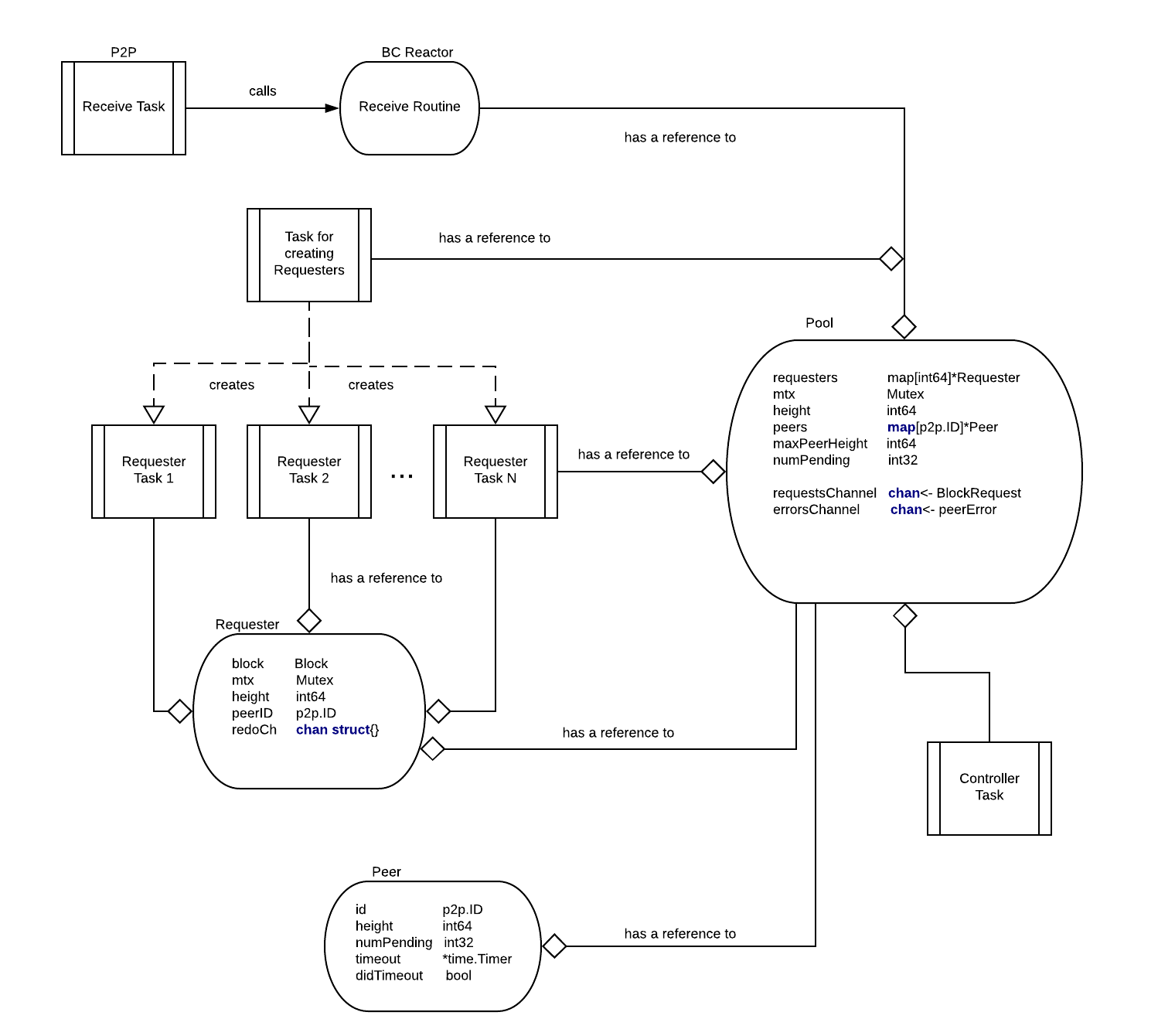
Data structures
These are the core data structures necessarily to provide the Blocksync Reactor logic.
Requester data structure is used to track assignment of request for block at position height to a peer with id equals to peerID.
type Requester {
  mtx          Mutex
  block        Block
  height       int64
  peerID       p2p.ID
  redoChannel  chan p2p.ID //redo may send multi-time; peerId is used to identify repeat
}
Pool is a core data structure that stores last executed block (height), assignment of requests to peers (requesters), current height for each peer and number of pending requests for each peer (peers), maximum peer height, etc.
type Pool {
  mtx                Mutex
  requesters         map[int64]*Requester
  height             int64
  peers              map[p2p.ID]*Peer
  maxPeerHeight      int64
  numPending         int32
  store              BlockStore
  requestsChannel    chan<- BlockRequest
  errorsChannel      chan<- peerError
}
Peer data structure stores for each peer current height and number of pending requests sent to the peer (numPending), etc.
type Peer struct {
  id           p2p.ID
  height       int64
  numPending   int32
  timeout      *time.Timer
  didTimeout   bool
}
BlockRequest is internal data structure used to denote current mapping of request for a block at some height to a peer (PeerID).
type BlockRequest {
  Height int64
  PeerID p2p.ID
}
Receive routine of Blocksync Reactor
It is executed upon message reception on the BlocksyncChannel inside p2p receive routine. There is a separate p2p receive routine (and therefore receive routine of the Blocksync Reactor) executed for each peer. Note that try to send will not block (returns immediately) if outgoing buffer is full.
handleMsg(pool, m):
    upon receiving bcBlockRequestMessage m from peer p:
      block = load block for height m.Height from pool.store
      if block != nil then
        try to send BlockResponseMessage(block) to p
      else
        try to send bcNoBlockResponseMessage(m.Height) to p

    upon receiving bcBlockResponseMessage m from peer p:
      pool.mtx.Lock()
      requester = pool.requesters[m.Height]
      if requester == nil then
        error("peer sent us a block we didn't expect")
        continue

      if requester.block == nil and requester.peerID == p then
        requester.block = m
        pool.numPending -= 1  // atomic decrement
        peer = pool.peers[p]
        if peer != nil then
          peer.numPending--
          if peer.numPending == 0 then
            peer.timeout.Stop()
            // NOTE: we don't send Quit signal to the corresponding requester task!
        else
          trigger peer timeout to expire after peerTimeout
      pool.mtx.Unlock()


    upon receiving bcStatusRequestMessage m from peer p:
      try to send bcStatusResponseMessage(pool.store.Height)

    upon receiving bcStatusResponseMessage m from peer p:
      pool.mtx.Lock()
      peer = pool.peers[p]
      if peer != nil then
        peer.height = m.height
      else
        peer = create new Peer data structure with id = p and height = m.Height
        pool.peers[p] = peer

      if m.Height > pool.maxPeerHeight then
        pool.maxPeerHeight = m.Height
      pool.mtx.Unlock()

onTimeout(p):
  send error message to pool error channel
  peer = pool.peers[p]
  peer.didTimeout = true
Requester tasks
Requester task is responsible for fetching a single block at position height.
fetchBlock(height, pool):
  while true do {
    peerID = nil
    block = nil
    peer = pickAvailablePeer(height)
    peerID = peer.id

    enqueue BlockRequest(height, peerID) to pool.requestsChannel
    redo = false
    while !redo do
      select {
        upon receiving Quit message do
          return
        upon receiving redo message with id on redoChannel do
          if peerID == id {
            mtx.Lock()
            pool.numPending++
            redo = true
            mtx.UnLock()
          }
      }
    }

pickAvailablePeer(height):
  selectedPeer = nil
  while selectedPeer = nil do
    pool.mtx.Lock()
    for each peer in pool.peers do
      if !peer.didTimeout and peer.numPending < maxPendingRequestsPerPeer and peer.height >= height then
        peer.numPending++
        selectedPeer = peer
        break
    pool.mtx.Unlock()

    if selectedPeer = nil then
      sleep requestIntervalMS

  return selectedPeer
sleep for requestIntervalMS
Task for creating Requesters
This task is responsible for continuously creating and starting Requester tasks.
createRequesters(pool):
  while true do
    if !pool.isRunning then break
    if pool.numPending < maxPendingRequests or size(pool.requesters) < maxTotalRequesters then
      pool.mtx.Lock()
      nextHeight = pool.height + size(pool.requesters)
      requester = create new requester for height nextHeight
      pool.requesters[nextHeight] = requester
      pool.numPending += 1 // atomic increment
      start requester task
      pool.mtx.Unlock()
    else
      sleep requestIntervalMS
      pool.mtx.Lock()
      for each peer in pool.peers do
        if !peer.didTimeout && peer.numPending > 0 && peer.curRate < minRecvRate then
          send error on pool error channel
          peer.didTimeout = true
        if peer.didTimeout then
          for each requester in pool.requesters do
            if requester.getPeerID() == peer then
              enqueue msg on requestor's redoChannel
          delete(pool.peers, peerID)
      pool.mtx.Unlock()
Main blocksync reactor controller task
main(pool):
  create trySyncTicker with interval trySyncIntervalMS
  create statusUpdateTicker with interval statusUpdateIntervalSeconds
  create switchToConsensusTicker with interval switchToConsensusIntervalSeconds

  while true do
    select {
   upon receiving BlockRequest(Height, Peer) on pool.requestsChannel:
     try to send bcBlockRequestMessage(Height) to Peer

   upon receiving error(peer) on errorsChannel:
     stop peer for error

   upon receiving message on statusUpdateTickerChannel:
     broadcast bcStatusRequestMessage(bcR.store.Height) // message sent in a separate routine

   upon receiving message on switchToConsensusTickerChannel:
     pool.mtx.Lock()
     receivedBlockOrTimedOut = pool.height > 0 || (time.Now() - pool.startTime) > 5 Seconds
     ourChainIsLongestAmongPeers = pool.maxPeerHeight == 0 || pool.height >= pool.maxPeerHeight
     haveSomePeers = size of pool.peers > 0
     pool.mtx.Unlock()
     if haveSomePeers && receivedBlockOrTimedOut && ourChainIsLongestAmongPeers then
       switch to consensus mode

          upon receiving message on trySyncTickerChannel:
            for i = 0; i < 10; i++ do
              pool.mtx.Lock()
              firstBlock = pool.requesters[pool.height].block
              secondBlock = pool.requesters[pool.height].block
              if firstBlock == nil or secondBlock == nil then continue
              pool.mtx.Unlock()
              verify firstBlock using LastCommit from secondBlock
              if verification failed
                pool.mtx.Lock()
                peerID = pool.requesters[pool.height].peerID
                redoRequestsForPeer(peerId)
                delete(pool.peers, peerID)
                stop peer peerID for error
                pool.mtx.Unlock()
              else
                delete(pool.requesters, pool.height)
                save firstBlock to store
                pool.height++
                execute firstBlock
    }

redoRequestsForPeer(pool, peerId):
  for each requester in pool.requesters do
    if requester.getPeerID() == peerID
     enqueue msg on redoChannel for requester
Channels
Defines maxMsgSize for the maximum size of incoming messages,
SendQueueCapacity and RecvBufferCapacity for maximum sending and
receiving buffers respectively. These are supposed to prevent amplification
attacks by setting up the upper limit on how much data we can receive & send to
a peer.
Sending incorrectly encoded data will result in stopping the peer.